Source: Today I found out
All authentic item...invicta,tommy hilfiger,casio,stuhrling,dockers,britney spears,hugo boss,abu garcia,shimano and a lot more branded item at affordable prices
Showing posts with label Good To Know. Show all posts
30 Aug 2012
24 Jun 2012
30 Things You Should Not Share on Social Media
- What chicken you are plucking or cow you’re milking on Farmville on Facebook
- How many you have killed on Mafia wars or where they are buried.. again on Facebook
- Party photos showing you inebriated or a hand placed where it shouldn’t be
- That you are having a party.. you might get more guests than you counted on
- Photos revealing you flirting with the bosses wife at the annual work Christmas party
- That you are having an affair
- That you are thinking of having an affair
- Complaints about your boss
- That you hate your job and want to leave.. you might get your wish.. involuntarily
- Don’t share photos or an event that reveals that you were not sick that day at work
- That are you are planning to take a sickie
- Drama with your friends
- Issues with your parents
- Passwords.. unless you have more money than brains
- Hints about passwords like dogs names
- Images and videos of your children
- Updates on Facebook after you have escaped from Jail and on the run (don’t laugh it has happened)
- Revealing your thoughts about a court case… when on jury duty
- Don’t link personal sites to professional business sites like LinkedIn.. don’t mix business with pleasure
- Financial information such as how much money you do or don’t have in your bank account
- Personal Information
- How to get more friends or followers.. it already sounds like a scam
- You are leaving on a holiday
- The dates you are away on your holiday
- Your daily schedule.. burglars have been known to use these little hints to their advantage
- Showing you doing something stupid .. not good for personal branding
- Your bodily functions
- Revealing extreme views on Race, Religion or politics
- What you had for breakfast
- Finally, If you are not comfortable about it … don’t share it
Labels:
Good To Know
6 Jun 2012
How to Stop Windows Update from Automatically Restarting Your Computer
You should know how to prevent Windows Update from automatically restarting your computer.
There are few more annoying default settings than Windows’ developers choosing to have the default on Windows Update be to automatically restart your computer and further not providing any obvious way to disable auto-restarts after a Windows update.. Sure, they have a “postpone” button that pops up, but that does little good if you happen to step away from your computer when it pops up to inform you it’s about to restart. Many a time I’ve been working on some article or piece of software and I take a break to go get a snack, only to come back and see my computer has automatically restarted, losing a portion, or sometimes all of my work. I also have a habit of opening multiple notepad windows containing temporary notes for an article or the like that are never meant to be saved that get lost in these cases. Or times where I’ve left my computer on overnight transferring large files, such as some of my website databases, only to see the next morning that Windows has helpfully restarted mid-transfer, so now I have to do it over again.
Luckily, there are a few ways you can set things up so that Windows will not be able to automatically restart your computer after a Windows update. The first way is to simply install some bit of software such as this free Shutdown Guard application, which prevents most applications on your computer from shutting down Windows, including Windows Update.
A second method top stop Windows automatically restarting is just to modify your Windows Update settings so that it will only download updates, but not install them until you tell it too (Start -> search Windows Update and open it -> select “Change Settings” -> then select from the drop down menu, “Download Updates, but Let Me Choose When to Install Them”). These two solutions are going to work best for people with “Home” or “Home Premium” versions of Windows.
For those who have “Professional” or “Ultimate” editions of Windows, the best way to stop Windows Update from automatically restarting your computer is to make a small tweak to your Windows Registry or Group Policies. These two methods may seem a little intimidating for non-techies, and indeed in general one should not go modifying these settings unless you know what you’re doing, but in this case the tweaks are quite simple.
An alternative method to using the Group Policy Editor is to manually edit the Windows Registry. With this method you simply do the following:
There are few more annoying default settings than Windows’ developers choosing to have the default on Windows Update be to automatically restart your computer and further not providing any obvious way to disable auto-restarts after a Windows update.. Sure, they have a “postpone” button that pops up, but that does little good if you happen to step away from your computer when it pops up to inform you it’s about to restart. Many a time I’ve been working on some article or piece of software and I take a break to go get a snack, only to come back and see my computer has automatically restarted, losing a portion, or sometimes all of my work. I also have a habit of opening multiple notepad windows containing temporary notes for an article or the like that are never meant to be saved that get lost in these cases. Or times where I’ve left my computer on overnight transferring large files, such as some of my website databases, only to see the next morning that Windows has helpfully restarted mid-transfer, so now I have to do it over again.
Luckily, there are a few ways you can set things up so that Windows will not be able to automatically restart your computer after a Windows update. The first way is to simply install some bit of software such as this free Shutdown Guard application, which prevents most applications on your computer from shutting down Windows, including Windows Update.
A second method top stop Windows automatically restarting is just to modify your Windows Update settings so that it will only download updates, but not install them until you tell it too (Start -> search Windows Update and open it -> select “Change Settings” -> then select from the drop down menu, “Download Updates, but Let Me Choose When to Install Them”). These two solutions are going to work best for people with “Home” or “Home Premium” versions of Windows.
For those who have “Professional” or “Ultimate” editions of Windows, the best way to stop Windows Update from automatically restarting your computer is to make a small tweak to your Windows Registry or Group Policies. These two methods may seem a little intimidating for non-techies, and indeed in general one should not go modifying these settings unless you know what you’re doing, but in this case the tweaks are quite simple.
Windows XP Start -> Run -> and type: gpedit.msc and hit enter
Now drill down as follows: Local Computer Policy -> Computer Configuration -> Administrative Templates -> Windows Components -> Windows Update
Now double click on “No auto-restart for scheduled Automatic Updates Installation”
In the dialogue box that comes up, select “Enabled” and click “OK”.
Windows Vista/7:
Start -> search for gpedit.msc or search Run, select it, and then type gpedit.msc
Now drill down as follows: Computer Configuration -> Administrative Templates -> Windows Components -> Windows Update
Double click on “No auto-restart for scheduled Automatic Updates installations”
In the dialogue box that comes up, select “Enabled” and click “OK”
Now drill down as follows: Local Computer Policy -> Computer Configuration -> Administrative Templates -> Windows Components -> Windows Update
Now double click on “No auto-restart for scheduled Automatic Updates Installation”
In the dialogue box that comes up, select “Enabled” and click “OK”.
Windows Vista/7:
Start -> search for gpedit.msc or search Run, select it, and then type gpedit.msc
Now drill down as follows: Computer Configuration -> Administrative Templates -> Windows Components -> Windows Update
Double click on “No auto-restart for scheduled Automatic Updates installations”
In the dialogue box that comes up, select “Enabled” and click “OK”
- Start -> for XP select Run then type regedit and hit enter, for Vista/7 search regedit and open it
- Now drill down as follows: HKEY_LOCAL_MACHINE -> SOFTWARE -> Policies -> Microsoft -> Windows -> WindowsUpdate
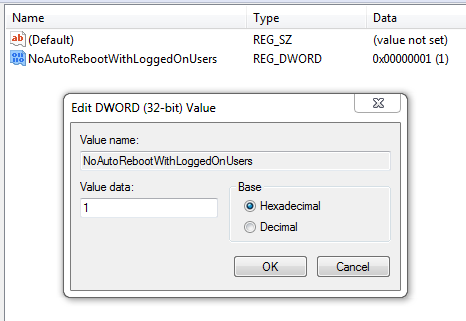
- Right click on the right hand side of the window that’s open near where you see the “(Default) | REG_Z” key, then hit New -> DWORD (32-bit) Value and name it NoAutoRebootWithLoggedOnUsers
- Right click on NoAutoRebootWithLoggedOnUsers and select Modify, then give it a value of 1, which equates to “true”.
Obviously if you do any of these methods, make sure to periodically restart your computer when you see updates have been installed. Or in the case of stopping automatic updates from installing automatically, make sure to install them periodically and restart. Making sure all the Windows Updates are installed on your machine will help prevent your computer from getting infected with viruses and the like and will usually also help make it more stable, thanks to installing all the bug fixes Microsoft issues. Many of these updates require that the computer restarts to take effect, so it’s important to do so, just preferably when you want it to restart and not when my computer wants. 
By Daven Hiskey
Labels:
Good To Know
8 May 2012
The Truth about Mr Bean
Today I found out Rowan Atkinson, the guy who played “Mr. Bean”, has a master’s degree in electrical engineering.
Atkinson originally received an undergraduate degree in electrical engineering (EE) at Newcastle University before enrolling in an EE master’s program at The Queen’s College Oxford in 1975. While working towards this degree, he also pursued acting on the side with a variety of clubs, including: the Oxford University Dramatic Society; the Oxford Revue; and the Experimental Theatre Club.
The character of Mr. Bean, though not the name, was originally developed during this time period. The character’s modus operandi was to be a “child in a grown man’s body”, based on similar brands of “physical humor” comedy portrayed by such famed actors as Buster Keaton, Charlie Chaplin, and Jacques Tati (particularly the character of “Monsieur Hulot” portrayed by Tati).
In retrospect, the development of the character of Mr. Bean proved to be a more profitable use of Atkinson’s time in college than actual course study. The subsequent TV program based on this character lasted five years and was wildly popular throughout the UK with peak ratings as high as just shy of 19 million viewers. In addition to that, the two films made to date featuring this character, “Bean” and “Mr. Bean’s Holliday”, combined grossed nearly half a billion dollars worldwide in theaters ($250 million and $230 million respectively), while only costing $22 million to make the first film and $25 million for the second.
Bonus Factoids:
- In his early days of acting, Atkinson earned a truck driver’s license as a way to make extra money while he established himself as an actor.
- In the UK, a truck driver is called a “lorry driver”.
- Thanks in large part to the Mr. Bean character, along with various other roles he’s performed, Rowand Atkinson is today estimated to have a net worth of around $150 million.
- Atkinson’s oldest brother, Rupert, in 2000 barely lost the post of leader of the United Kingdom Independence Party (by a mere 16 votes).
- Buster Keaton, whose style of comedy was very similar to Mr. Bean, also inspired Jackie Chan’s brand of comedy, according to Chan’s autobiography.
- Keaton was named the seventh greatest director of all time by Entertainment Weekly. Further, he is ranked as the “21st greatest male actor of all time” by the American Film Institute. In his early silent films, he was known for delivering his brand of physical comedy with a completely straight face, which he found typically drew bigger laughs than if he was more animated in his expressions.
- Keaton got his start in show business at just four years old in 1899, performing in his parent’s comedy sketch. His role was typically to get his dad angry at him, at which point his dad would toss him across the stage to land in the orchestra pit or to slam against the scenery. While this may sound rough, his dad taught him how to land such that he wouldn’t ever get hurt. Although, his father faced being arrested several times for child abuse, only getting off when Keaton would show that he had not been hurt in any way by being tossed. Keaton stated “The secret is in landing limp and breaking the fall with a foot or a hand. It’s a knack. I started so young that landing right is second nature with me. Several times I’d have been killed if I hadn’t been able to land like a cat. Imitators of our act don’t last long, because they can’t stand the treatment.”
- Keaton was diagnosed with terminal lung cancer in 1966, but his doctors never told him he was going to die; they told him he just had bronchitis, though they knew it was lung cancer. His last wife, Eleanor Keaton, also died of lung cancer 32 years later.
- A major car enthusiast, Atkinson occasionally writes for different British automobile magazines, such as Car, Octane, Evo, and SuperClassics and has appeared on the motor vehicle show, Top Gear. He also owns several cars including the exceptionally rare McLaren F1, which he has wrecked twice, once in 1999 and once just a few months ago in August of 2011. In the first wreck, he rear ended a $600 Mini Metro car with his car worth then about $1+ million (today worth more in the vicinity of $4 million). In the second accident, he hit a tree.
- The McLaren F1 can go from 0-60 mph in 3.2 seconds and has a top speed of around 240 mph. McLaren only produced 106 of these cars.
- One of the earliest known performances of the Mr. Bean-style character done by Atkinson was in a 1979 show called “Canned Laughter”. The character, while similarly portrayed as Mr. Bean, went under the name “Robert Box”.
- The name of “Mr. Bean” wasn’t thought up until after Atkinson landed the Mr. Bean show. During early production, they threw around a variety of names for the character, originally “Mr. White”, then several possible names based on vegetables and other plant life like “Mr. Carrot” or “Mr. Cauliflower”. Eventually, they settled on “Mr. Bean”.
- Other notable characters done by Atkinson include: Zazu on Disney’s The Lion King; Johnny English; and various characters on the historical sitcom Blackadder, among many others.
- The Queen’s College Oxford was founded nearly 700 years ago in 1341 by Robert de Eglesfield, who was a chaplain to the wife of King Edward III of England, Queen Philippa of Hainault.
- The city of Oxford was originally named Oxenaforda, which just meant “Ford of the Oxen”.
Labels:
Good To Know
The most used apps on iphone 2011??
Earlier this month, comScore released statistics regarding the top application downloads of all time for Apple's iPhone platform. According to that information, which showed that nearly half of the top 25 are games, many people assumed that games are making the iPhone the success it is today.
However, when looking at another metric, it seems that games might not be as popular as originally thought. When it comes to everyday use of applications, you see, there are several others that rank higher. Can you guess what they are? As it turns out, the most heavily used iPhone apps aren't games - they're weather applications.
This is according to new data from an upcoming report from market research firm Compete (and reported by MediaPost). The report states that 39% of iPhone users cited weather applications as the apps they used the most frequently, with 13% citing The Weather Channel app specifically. Following weather apps, there comes Facebook. The app earned second place with 25% of users reporting they accessed the Facebook iPhone app regularly. It's possible that it won't be too long before Facebook beats out weather for first place, though. The application is growing in popularity, adding nearly 1 million active users per month, and is at 30 million actives worldwide. It was also recently recognized by Apple as the #1 All Time Free App in the iPhone app store.
Next, after Facebook, comes the games. 20% of iPhone users reported games as the apps they used the most often. 10% reported music-related apps, and then the apps that followed dropped down to single-digit percentages. What may be most interesting about this study, though, is that it found people are seeking out apps for download by themselves instead of relying on recommendations from family and friends. According to the report, 60% of both iPhone and other smartphone users said they found the apps they wanted to download on their own. "It's surprising to see people actually spending time to self-discover," said Danielle Nohe, director of telecom and media-related research for Compete. That just goes to show these modern-day smartphones are really personal computers after all, aren't they?
However, when looking at another metric, it seems that games might not be as popular as originally thought. When it comes to everyday use of applications, you see, there are several others that rank higher. Can you guess what they are? As it turns out, the most heavily used iPhone apps aren't games - they're weather applications.
This is according to new data from an upcoming report from market research firm Compete (and reported by MediaPost). The report states that 39% of iPhone users cited weather applications as the apps they used the most frequently, with 13% citing The Weather Channel app specifically. Following weather apps, there comes Facebook. The app earned second place with 25% of users reporting they accessed the Facebook iPhone app regularly. It's possible that it won't be too long before Facebook beats out weather for first place, though. The application is growing in popularity, adding nearly 1 million active users per month, and is at 30 million actives worldwide. It was also recently recognized by Apple as the #1 All Time Free App in the iPhone app store.
Next, after Facebook, comes the games. 20% of iPhone users reported games as the apps they used the most often. 10% reported music-related apps, and then the apps that followed dropped down to single-digit percentages. What may be most interesting about this study, though, is that it found people are seeking out apps for download by themselves instead of relying on recommendations from family and friends. According to the report, 60% of both iPhone and other smartphone users said they found the apps they wanted to download on their own. "It's surprising to see people actually spending time to self-discover," said Danielle Nohe, director of telecom and media-related research for Compete. That just goes to show these modern-day smartphones are really personal computers after all, aren't they?
Labels:
Good To Know
5 May 2012
#1 Facts about Euro until Now!
| Performance | ||||
| Highest Gate | 84,459 England v Switzerland | |||
| Lowest Gate | 103 Andorra v Armenia | |||
| Average Attendance | 21,265 | |||
| Aggregate Attendance | 3,104,725 | |||
| Biggest Home Win | Netherlands 11-0 San Marino | |||
| Biggest Away Win | San Marino 0-5 Sweden | |||
| Highest Team Score | 11: Netherlands 11-0 San Marino | |||
| Highest Aggregate Score | 11: Netherlands 11-0 San Marino | |||
| Current Win Sequence | 6 games: Germany | |||
| Current Unbeaten Sequence | 6 games: Germany, Ireland, Russia, Italy, Romania, France, Greece | |||
| Current Losing Sequence | 6 games: Andorra | |||
| Current Winless Sequence | 6 games: Andorra, Malta | |||
| Longest Win Sequence | 6 games: Germany | |||
| Longest Unbeaten Sequence | 6 games: Germany, Ireland, Russia, Italy, Romania, France, Greece | |||
| Longest Losing Sequence | 6 games: Andorra | |||
| Longest Winless Sequence | 6 games: Andorra, Malta | |||
Labels:
Good To Know
2 May 2012
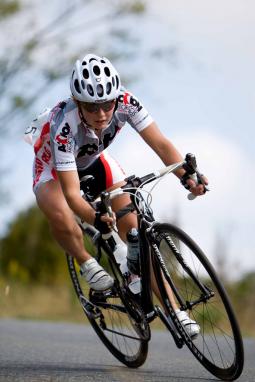
Why Men’s Bicycles Have a Horizontal Crossbar and Women’s Bicycles Typically Don’t
It would seem that having a slanted crossbar like on women’s bikes would make much more sense for men’s bikes, decreasing the chance of racking the guy if he slips off the pedals or the like. However, there is actually a really good reason to have a horizontal crossbar on a bike; namely, the horizontal crossbar ends up adding quite a bit of strength to the frame of the bike. This was particularly important in some of the early bikes, which were often made of significantly weaker materials than modern day frames, occasionally even being made of wood.
The problem with this horizontal crossbar was that women all used to wear dresses. So when a woman wanted to get on a bike, she’d have to lift her leg over the bike frame’s crossbar, which was quite scandalous for the time as it often exposed quite a bit of leg and possibly some underwear under her dress. Thus, bike makers began making bike models just for women that slanted the top crossbar down so that the women could mount and dismount the bikes without lifting their legs very high. Modifying the crossbar like that significantly weakened the frames of the bicycles, but this was considered acceptable as it wasn’t very lady like for women to ride their bikes as roughly as some men anyways.
This tradition has continued to this day, even though most women don’t go around riding bikes in dresses or skirts anymore. For the most part, on modern bikes, this weakening of the frame by slanting the crossbar isn’t significant enough to cause any concern for bikes, even on rough terrain, given modern materials that the frames are made of. Indeed, many BMX bikes for men are now designed with the slanted crossbar to reduce the chance of injury while doing tricks.
However, among higher end bikes made for women, this tradition of not having a horizontal crossbar is starting to go away, even though the added strength from a horizontal crossbar isn’t typically necessary anymore, particularly with carbon fiber frames. On these high end bikes, the differences between the men’s and the women’s bikes now tends to be reflected in the design by accounting for shorter torsos and arms on most women; modified hip placement; modified seat design; and the like.
- The highest speed ever achieved on a bicycle with the rider in an upright position with no external help, such as going downhill or wind or the like, was 51.29 mph (82.52 km/h); this record was set by Jim Glover in 1986. He maintained close to this speed for about 656 feet (200 m).
- The highest documented speed reached by any vehicle powered solely by a human without any external help, was 82.29 mph (132.449 km/h); this record was set by Sam Whittingham in 2008.
- The ball bearing, pneumatic tires, chain-driven sprockets, spoke tensioned wheels, and several other technological advances were originally invented for the bicycle, but many of these advancements played important roles in the eventual development of automobiles, as well as contributed to other manufacturing fields.
- There are about one billion bicycles in existence world-wide. For reference, there are “only” about 500 million automobiles in the world today.
- The first model of bicycle that is principally the same as modern day bicycles was created by J.K. Starley in 1885 and was called the Rover. This bike featured the first successful implementation of a chain drive, which mounted to the rear wheel. This got around the problem found in many bikes of the day where the pedals were directly attached to the front wheel, which made it difficult to steer and pedal at the same time.
- The first practical pneumatic tire was invented by John Boyd Dunlop in 1888 and very quickly became standard on all bikes and eventually ubiquitous on all automobiles. Dunlop created this type of tire for use on his son’s bicycle. His son had previously had a lot of trouble with headaches when he rode his bike. The pneumatic tire made for a significantly smoother ride than wheels of the day, so the hope was that creating this smoother ride would decrease his son’s headaches when riding.
Source: today i found out
Labels:
Good To Know
24 Apr 2012
10 things you can do to help save the earth..lets do it together!!
- Save energy to save money.
- Set your thermostat a few degrees lower in the winter and a few degrees higher in the summer to save on heating and cooling costs.
- Install compact fluorescent light bulbs (CFLs) when your older incandescent bulbs burn out.
- Unplug appliances when you're not using them. Or, use a "smart" power strip that senses when appliances are off and cuts "phantom" or "vampire" energy use.
- Wash clothes in cold water whenever possible. As much as 85 percent of the energy used to machine-wash clothes goes to heating the water.
- Use a drying rack or clothesline to save the energy otherwise used during machine drying.
- Save water to save money.
- Take shorter showers to reduce water use. This will lower your water and heating bills too.
- Install a low-flow showerhead. They don't cost much, and the water and energy savings can quickly pay back your investment.
- Make sure you have a faucet aerator on each faucet. These inexpensive appliances conserve heat and water, while keeping water pressure high.
- Plant drought-tolerant native plants in your garden. Many plants need minimal watering. Find out which occur naturally in your area.
- Less gas = more money (and better health!).
- Walk or bike to work. This saves on gas and parking costs while improving your cardiovascular health and reducing your risk of obesity.
- Consider telecommuting if you live far from your work. Or move closer. Even if this means paying more rent, it could save you money in the long term.
- Lobby your local government to increase spending on sidewalks and bike lanes. With little cost, these improvements can pay huge dividends in bettering your health and reducing traffic.
- Eat smart.
- If you eat meat, add one meatless meal a week. Meat costs a lot at the store-and it's even more expensive when you consider the related environmental and health costs.
- Buy locally raised, humane, and organic meat, eggs, and dairy whenever you can. Purchasing from local farmers keeps money in the local economy.
- Watch videos about why local food and sustainable seafood are so great.
- Whatever your diet, eat low on the food chain. This is especially true for seafood.
- Skip the bottled water.
- Use a water filter to purify tap water instead of buying bottled water. Not only is bottled water expensive, but it generates large amounts of container waste.
- Bring a reusable water bottle, preferably aluminum rather than plastic, with you when traveling or at work.
- Check out this short article for the latest on bottled water trends.
- Think before you buy.
- Go online to find new or gently used secondhand products. Whether you've just moved or are looking to redecorate, consider a service like mudah.my or onlinerevo.net to track down furniture, appliances, and other items cheaply or for free.
- Check out garage sales, thrift stores, and consignment shops for clothing and other everyday items.
- When making purchases, make sure you know what's "Good Stuff" and what isn't.
- Watch a video about what happens when you buy things. Your purchases have a real impact, for better or worse.
- Borrow instead of buying.
- Borrow from libraries instead of buying personal books and movies. This saves money, not to mention the ink and paper that goes into printing new books.
- Share power tools and other appliances. Get to know your neighbors while cutting down on the number of things cluttering your closet or garage.
- Buy smart.
- Buy in bulk. Purchasing food from bulk bins can save money and packaging.
- Wear clothes that don't need to be dry-cleaned. This saves money and cuts down on toxic chemical use.
- Invest in high-quality, long-lasting products. You might pay more now, but you'll be happy when you don't have to replace items as frequently (and this means less waste!).
- Keep electronics out of the trash.
- Keep your cell phones, computers, and other electronics as long as possible.
- Donate or recycle them responsibly when the time comes. E-waste contains mercury and other toxics and is a growing environmental problem.
- Recycle your cell phone.
- Ask your local government to set up an electronics recycling and hazardous waste collection event.
- Make your own cleaning supplies.
- The big secret: you can make very effective, non-toxic cleaning products whenever you need them. All you need are a few simple ingredients like baking soda, vinegar, lemon, and soap.
- Making your own cleaning products saves money, time, and packaging-not to mention your indoor air quality.
Labels:
Good To Know
Facts about Earth~~Happy Earth Day~~04/12
- The Earth is around 4.6 billion years old.
- The Earth is the densest planet in the Solar System.
- The Earth’s atmosphere is composed mainly of nitrogen (78%), oxygen (21%), argon (.93%), and carbon dioxide (0.03%).
- Earth’s atmosphere divided in 5 sections from the surface: Troposhere (0-13 km), Ozone Layer (13-25 km), Stratosphere (25-50 km), Mesosphere (50-75 km), and Thermosphere (75-150 km)
- Earth is the fifth largest planet in the Solar System.
- The Diameter of the Earth is 12,756 km (7,926 miles)
- The earth’s orbital speed is 29.8 km per second.
- Earth has only one satellite, the Moon. The Moon is the second brightest object in the sky from Earth.
- Earth has an average surface temperature of 13 degrees C (55.4 degrees F).
- The greenhouse effect raises Earth’s temperature 35 degrees C (95 degrees F).
- Earth’s distance from the Sun – Min. 146 million km (91million miles) Max. 152 million km (94.5 million miles).
- Earth is composed of: iron (32%), oxygen (30%), silicon (15%), magnesium (14%), sulfur (3%), nickel (2%), calcium (1.5%), aluminum (1/4%) and the remainder made up of other elements.
- Earths main tectonic plates: African plate, Antarctic plate, Indo-Australian Plate, Eurasian Plate, North American Plate, South American Plate, and the Pacific Plate.
- Earth has several layers with unique chemical and seismic properties: Crust (0-40 km), upper mantle (40-400 km), transition region (400-650 km), lower mantle (650-2700 km), D layer (2700-2890 km), outer core (2890-5150 km), and the inner core (5150-6378 km) from the surface.
Labels:
Good To Know
18 Apr 2012
How to spot fake LV(Louis Vuitton) Bag?
1. Know your bag!
Was it ever made by Louis Vuitton?
Try your
bag on at a boutique, check the VUITTON website, or Elux, buy a catalog-
etc, but make sure that the bag you are looking for was ever made by
Louis Vuitton. This is especially common in Multicolore bags- (there
was never an Multicolor Backpack, Ellipse, Papillon etc), Cherry
Blossom (no CB Speedy, Alma nor Cabas tote, Pegase), Cerises (no
Papillon, Ellipse, Cabas Piano, Mezzo or Alto) or vintage pieces.
Know its parts: What is it "supposed"
to be lined in? Should it have feet? What does the base look like?
Should it have a d-ring inside? Where? Does it have a date code?
Should it? Where?You can check the Vuitton website or your local
boutique for this information... you can also purchase more detailed
guides here on eBay that include such details... For example: If it is
supposed to be lined in brown cotton canvas, it needs to be lined in
brown cotton canvas. There have never been brown suede linings- even in
the vintage pieces. Alcantara kind of looks like a suede-y material,
but it isn't suede and although is found in a greyish mushroomy color,
it isn't found in dark brown. A Speedy of any age should have brown
cotton canvas lining, so if you see any other lining- you know it isn't
authentic. The lining of a Speedy has NEVER looked like this:
Know its Monogram placement: Louis Vuitton has been in
production since 1854! Their style is classic, and quality-
phenomenal! The traditional Monogram Toile canvas that is so popular
today- had its beginnings in 1896. The monogram itself can give clues
as to authenticity. Louis Vuitton is very careful about the way that
the monogram is placed on any piece. Most of its styles are the same
today as they were when they first came out- with a few exceptions. The
actual LV monogram is usually (with the exception of some vintage
pieces) symetrical from side to side in all monogram styles
(traditional, Multicolore, Cerises, Mini mono, Vernis etc.) as you can
see in this Louis Vuitton Speedy (notice where the LVs are in relation
to the handles, sides, quatrefoils etc)
Watch the stitching: Louis Vuitton is very careful
with it's stitching. Stitching should be very even and regular. The
same number of stitches will be found in similar locations on similar
bags... for example the leather tab that the handle attaches onto on any
size monogram Speedy bag will always have 5 regular, even stitches
across the top, like this:
Watch the age: While vintage pieces
follow most of the rules that I discuss in this guide, there are
definite differences in vintage pieces. For example, all French Company
pieces vary slightly... so if you are looking at a French Company
Vintage Vuitton piece, it may differ a bit. For instance, the FC Speedy
30 does NOT always have 5 stitches across the top, does NOT have upside
down LVs on one side, and does NOT have Louis Vuitton embossed in the
hardware. I'm currently writing a guide to help with these vintage
gems- so watch out for it.
Made in Spain? Yes, while it is true
that authentic Louis Vuitton is made in France, for over 25 years, Louis
Vuitton has also produced bags in the USA, Spain, Germany and Italy.
It is not true that a Louis Vuitton bag has to be marked "Made in
France" to be authentic. Here is the embossed markings of an authentic
Louis Vuitton bucket bag, Made in the USA:
What about the "Upside Down LVs"? People email me all
the time about this one... Some styles of authentic Louis Vuitton WILL
have "upside down" LVs on the backside. The reason for this is that
Louis Vuitton uses one continuous piece of leather that wraps around
from the front to back, without a seam on the bottom- and so, the
backside has upside down logos. This is true on the Speedy styles
(except French Company Speedys), the Keepalls, Papillons, and some
similar styles. Most monogram pieces (any piece with a separate piece
of canvas or leather on the bottom) will have the LVs rightside up on
both sides. Here is the backside of an authentic Speedy 25:
What about the patches? It is true
that many older fake bags had patches on the interior and exterior that
simply were never there on authentic versions. Fake exterior patch
followed by fake interior patch:
However, some authentic bags DO have them! This is
especially true of vintage pieces where there is a round patch meant for
personalized embossing like this:
Some current bags also have patches inside, like the Viva Cite:
The Fonts: Louis Vuitton uses a very specific font.
I've noticed that a few counterfieters have begun to do a better job at
knocking it off... so be careful, but current LV fonts will ALL look
like the one on the patch above. Notice the VERY round "O"s. Here is
an example of two straps- one authentic, one a "better" fake. Can you
tell the difference?
Labels:
Good To Know
14 Apr 2012
What does Jewel in Watches means??
Jewel bearings were invented and introduced in watches by Nicolas Fatio (or Facio) de Duillier and Pierre and Jacob Debaufre around 1702
to reduce friction. They did not become widely used until the mid 19th
century. Until the 20th century they were ground from tiny pieces of
natural gems. Watches often had garnet, quartz, or even glass jewels; only top quality watches used sapphire, ruby, or diamond.
In 1902, a process to grow artificial sapphire crystals was invented,
making jewels much cheaper. Jewels in modern watches are all synthetic
sapphire or (usually) ruby, made of corundum (Al2O3),
one of the hardest substances known. The only difference between
sapphire and ruby is that different impurities have been added to change
the color; there is no difference in their properties as a bearing.The advantage of using jewels is that their ultrahard slick surface has a lower coefficient of friction with metal. The static coefficient of friction of steel-on-steel is 0.58, while that of sapphire-on-steel is 0.10-0.15.
Why they are used
Jewels serve two purposes in a watch. First, reduced friction can increase accuracy. Friction in the wheel train bearings and the escapement causes slight variations in the impulses applied to the balance wheel,
causing variations in the rate of timekeeping. The low, predictable
friction of jewel surfaces reduces these variations. Second, they can
increase the life of the bearings. In unjeweled bearings, the pivots of
the watch's wheels rotate in holes in the plates supporting the
movement. The sideways force applied by the driving gear causes more
pressure and friction on one side of the hole. In some of the wheels,
the rotating shaft can eventually wear away the hole until it is oval
shaped, and the watch stops.
Types
- Pallets - These are the angled rectangular surfaces on the lever that are pushed against by the teeth of the escape wheel. They are the main source of friction in a watch movement, and were one of the first sites to which jewels were applied.
- Impulse pin - The off center pin on a disk on the balance staff which is pushed by the lever fork, to keep the balance wheel moving.
In bearings two different types are used:
- Hole jewels - These are donut shaped sleeve bearings used to support the arbor (shaft) of most wheels.
- Capstones or cap jewels - When the arbor of a wheel is in the vertical position, the shoulder of the arbor bears against the side of the hole jewel, increasing friction. This causes the rate of the watch to change when it is in different positions. So in bearings where friction is critical, such as the balance wheel pivots, flat capstones are added at each end of the arbor. When the arbor is in a vertical position, its rounded end bears against the surface of the capstone, lowering friction.
Labels:
Good To Know,
Watch
13 Apr 2012
Do you know about Sun??
- Light travels from the Sun to the Earth in about 8 minutes and 19 seconds.
- While it only takes 8 minutes and 19 seconds for the light from the surface of the sun to reach us, it actually takes about 10,000-170,000 years for a photon to travel from the core of the sun to the surface.
- Once regarded by astronomers as a small and relatively insignificant star, the Sun is now known to be brighter than about 85% of the stars in the Milky Way.
- The Sun has an effective surface temperature of 5780 K, which is equivalent to just under 10,000 F and 5500 C.
- The core of the Sun has a density almost 150 times the density of water on Earth. The temperature at the core is close to 14 million Kelvins and Celsius degrees, or 25 million degrees F.
- About 3/4 of the Sun’s mass consists of hydrogen, with most of the rest being helium (23.8%) and about 2% remaining consisting of other elements such as iron, oxygen, carbon, neon, and a variety of others.
- The Sun generates its energy from nuclear fusion at its core fusing the hydrogen nuclei into helium. The nuclear fusion is self regulating; if the Sun’s diameter gets smaller while maintaining the same mass, the pressure at the core increases creating more nuclear fusion which in turn causes it to expand. If it expands maintaining the same mass, the pressure lessens in the core causing less nuclear fusion. So a natural equilibrium has resulted in this process with our Sun, though there are stars that can be observed going through this process of massive expansion and contraction at very steady rates.
- At the core of the Sun, nuclear fusion power produced is estimated at about 276.5 watts/m^3. Interestingly this power production is more equivalent to a reptile’s metabolic energy production than what we would think like a nuclear bomb.
- This is in contrast to the amount of energy per (W/m^2) deposited on the surface of the Earth from the Sun, which is about 1368 W/m^2.
- Each second more than four million tons of matter are converted to energy within the Suns core. At this rate, the Sun has so far converted 100 Earth masses of matter into energy. This will give the sun an effective lifetime as a main sequence star of about 10 billion years with about 5 billion years to go.
- The Sun does not have enough mass to go supernova and explode. However, in about 5 billion years it will enter a red giant phase steadily expanding until it consumes the Earth. But fear not, the Earth will already be dead in about 1 billion years due to the fact that the sun becomes about 10% brighter every billion years; so in 1 billion years the Earth’s surface temperature will be such that no liquid water will be able to exist unprotected on the surface of the Earth.
- The Sun orbits the center of the Milky Way at a distance of approximately 24,000-26,000 light years.
- The Sun completes a clockwise orbit of the Milky Way center in about 225-250 million years.
- The Sun is about 150 million km or about 93 million miles from the Earth; this is by definition one astronomical unit (1 AU).
- The Sun is almost a perfect sphere; its diameter at its poles differs from the diameter at its equator by only 10 km or 6 miles.
- The area of the sun we call the “surface” is really just the outermost layer that radiates a significant amount of light. There is actually quite a bit of the Sun above that layer.
- The Sun’s magnetic field is less than half of what it was just 22 years ago. This has shrunken the Sun’s heliosphere which helps protect the earth from cosmic radiation. Because of this, the Earth is now being struck with significantly more cosmic radiation than just a couple decades ago.
Labels:
Good To Know
12 Apr 2012
Infographic: The differences between left and right brain people
Are you a right or left brain person...you should know it....checkout below infographics sources from Onlinecollege.com
Labels:
Good To Know
How to identify Iphone models?
There's some characteristic and specification either physical or operational specification we can list, check that out:
Identifying features
iPhone 4S
The model number on the back cover is: A1431 on the iPhone 4S (GSM China) A1387 on the iPhone 4S The front and back surfaces are flat and made of glass. There is a stainless steel band around the edges. The volume up and down buttons are marked with a "+" and "-" sign. There is micro-SIM tray on the right side that holds a micro-SIM card.
iPhone 4
The model number on the back cover is: A1349 on the iPhone 4 (CDMA model) A1332 on the iPhone 4 (GSM model) The front and back surfaces are flat and made of glass. There is a stainless steel band around the edges. The volume up and down buttons are marked with a "+" and "-" sign. The GSM model has a micro-SIM tray on the right side that holds a micro-SIM card. The CDMA model does not have a SIM tray.
iPhone 3GS
The model number on the back case is: A1325 on the iPhone 3GS (China) A1303 on the iPhone 3GS The back case is made of plastic. The imprint on the back case is the same bright and shiny silver as the Apple logo. The serial number is printed on the SIM tray.
iPhone 3G
The model number on the back case is: A1324 on the iPhone 3G (China) A1241 on the iPhone 3G The back case is made of plastic. The imprint on the back of the phone is less shiny than the Apple logo above it. The serial number is printed on the SIM tray.
iPhone
The model number on the back case is A1203. The back case is made of metal. The serial number is etched in the back case.
Important: Information about products not manufactured by Apple is provided for information purposes only and does not constitute Apple’s recommendation or endorsement. Please contact the vendor for additional information.
Identifying features
iPhone 4S
The model number on the back cover is: A1431 on the iPhone 4S (GSM China) A1387 on the iPhone 4S The front and back surfaces are flat and made of glass. There is a stainless steel band around the edges. The volume up and down buttons are marked with a "+" and "-" sign. There is micro-SIM tray on the right side that holds a micro-SIM card.
iPhone 4
The model number on the back cover is: A1349 on the iPhone 4 (CDMA model) A1332 on the iPhone 4 (GSM model) The front and back surfaces are flat and made of glass. There is a stainless steel band around the edges. The volume up and down buttons are marked with a "+" and "-" sign. The GSM model has a micro-SIM tray on the right side that holds a micro-SIM card. The CDMA model does not have a SIM tray.
iPhone 3GS
The model number on the back case is: A1325 on the iPhone 3GS (China) A1303 on the iPhone 3GS The back case is made of plastic. The imprint on the back case is the same bright and shiny silver as the Apple logo. The serial number is printed on the SIM tray.
iPhone 3G
The model number on the back case is: A1324 on the iPhone 3G (China) A1241 on the iPhone 3G The back case is made of plastic. The imprint on the back of the phone is less shiny than the Apple logo above it. The serial number is printed on the SIM tray.
iPhone
The model number on the back case is A1203. The back case is made of metal. The serial number is etched in the back case.
Important: Information about products not manufactured by Apple is provided for information purposes only and does not constitute Apple’s recommendation or endorsement. Please contact the vendor for additional information.
Labels:
Good To Know
11 Apr 2012
10 Apr 2012
Why Zippers Have YKK On Them
Today I found out why zippers have a YKK on them.
The YKK stands for Yoshida Kogyo Kabushikikaisha (say that five times fast). In 1934 Tadao Yoshida founded Yoshida Kogyo Kabushikikaisha (translated Yoshida Industries Limited). This company is now the worlds foremost zipper manufacturer, making about 90% of all zippers in over 206 facilities in 52 countries. In fact, they not only make the zippers, they also make the machines that make the zippers; no word on if they make the machines that make the parts that make up the machines that make the zippers.
Their largest factory in Georgia makes over 7 million zippers per day.
In any event, Mr. Yoshida’s company zipped to number one by practicing the “Cycle of Goodness”, as he called it. Namely, “No one prospers unless he renders benefit to others.” Using this principle, he endeavored to create the best zippers out there that would hold up over long periods of time in the end product. This in turn would benefit both the manufacturers who used his zippers and the end customer and because of these things benefit his company with higher repeat and referral sales, thus completing the “Cycle of Goodness” *zen moment*
So next time you’re zipping up, take a moment to remember Mr. Yoshida; also, if you’re going commando, careful with Captain Winky on the zip up. I can’t stress that enough.
Labels:
Good To Know
9 Apr 2012
20 Ways To Increase Your Facebook Likes and Engagement
20 Ways to Increase Your Facebook Likes and Engagement
- Advertise on Facebook to get more “likes”. This is the quickest way to grow your fan base.
- Rotate your ads “DAILY” people get tired of hearing the same thing in conversation so change your ad! Conversion (CTR) rates can drop by 50% after the first 24 hours. Do not “set and forget”
- Add Facebook Social Plugin Box to your Blog and Website (60% of my “likes” are achieved this way)
- Free exclusive video that can only be viewed if you like the page.
- Run a competition. Everyone likes a competition
- Make it obvious on a custom landing page by providing a big bold “Like our Page”
- Initially ask friends and family to like your page. A bit overdone but essential at the beginning
- Offer a free ebook to obtain a “like” (just like you should be doing for email subscriber acquisition)
- Post content from your blog to Facebook whenever you write a new post. Facebook users love receiving new content on Facebook without having to go looking for your blog. Treat Facebook as an extension of your blog.
- Provide enticing high resolution photos. Compelling photos that are appropriate for your target audience will keep them coming back and make them share and so drive more likes from their friends
- Ask questions regularly using Facebook’s native question app.
- Include a link to your Facebook page in your email signature
- Provide a compelling welcome video on your Facebook landing page
- Simple but often missed: Add a “follow us” on Facebook button near the top of your website and blog pages
- Create an incentivised “Like” page that gives people a reason to like your page.
- Include the Facebook like button on your email HTML template so that people can like your facebook page from the regular email newsletter
- Add a large custom banner to your blog and website asking to “Like
- Add a link to your Facebook page as one of your three LinkedIn website links that are part of your LinkedIn settings in your profile
- Add a newsworthy update that is relevant for your industry or market niche to your Facebook page every day
- Offer “Special” including discounts to Facebook fans. The majority of Facebook users “like” a page to obtain a discount
How have you increased your Facebook page “likes”?
Labels:
Good To Know
26 Mar 2012
Fun facts about F1 Circuits
Which track has NOT hosted the British Grand Prix?
Donington Park. Donington Park has only ever hosted one Grand Prix, in 1993, and was titled the European GP.
The British GP in 1993 was held at Silverstone. Silverstone hosted the race in 1950-1954, 56, 58, 60, 63 then every odd year until 1985 then from 1987 onwards. Brands Hatch hosted the race every even year from 1964 to 1986. Aintree hosted the race in 1955, 57, 59, 61-62.
How long was the Nurburgring circuit which hosted the German Grand Prix between 1951 and 1975?
14.17 miles. The circuit, built in 1925, gained the reputation as a fearsome race circuit, and one on only the greats would win at.
However, the Nurburgring does not hold the distinction of the longest circuit ever - that record belongs to Pescara (16 miles), which hosted a Formula One race in 1957.
How many circuits hosted the French GP from 1965 to 1968?
4. For the poor French spectators, four circuits hosted the French Grand Prix in four years. Clermont-Ferrand hosted the race in 1965, Reims in 1966, Le Mans (Bugatti) in 1967 and Rouen-les-Essarts in 1968.
Indeed, the French Grand Prix never found a permanent home until 1985 when the Paul Ricard circuit hosted the race from 1985-1990. Then Magny Cours (Circuit de Nevers) took over hosting duties from 1991 onwards.
Before being renamed the Circuit Gilles Villeneuve, what name was given to the Montreal circuit that hosted the Canadian Grand Prix from 1978?
Ile Notre Dame. The Il Notre Dame circuit was renamed after the death of the great Canadian driver Gilles Villeneuve in 1983.
The site was also the host of the World Expo in 1967, and was also the location of the rowing events during the 1976 Montreal Olympics.
Name the only track ever to host the Dutch Grand Prix?
Zandvoort.
Zandvoort hosted its first race in 1952, and held the race 30 times between then and 1985, when the race was dropped due to an expanding calender and also safety concerns about the Zandvoort circuit.
Which is not a name of a corner on the Spa-Francorchamps circuit?
Parabolica. The Parabolica is the name of the final corner at the Monza circuit.
Eau Rouge is a fearsome left-right-left downhill sweeper just after the La Source hairpin. Les Combes is a tricky right-left chicane after the straight out of Kemmel. Blanchimont is a long fast left hander after Stavelot.
Despite the success of Australian drivers, Australia did not host a round of the F1 World Championship until 1985. The city chosen to host the race was?
Adelaide.
The race took part on the city streets and also in Victoria Park Racecourse, where the start-finish line was located. At just 2.350 miles, it was one of the shortest circuits on the calender, a real machine breaker but also a great end of season race.
Where was the first Portuguese Grand Prix held?
Oporto. Oporto hosted the Portuguese in 1958 (won by Stirling Moss) and 1960 (won by Jack Brabham.) Lisbon hosted the race in 1959 (won by Stirling Moss.) Estoril hosted its first race in 1984 (won by Alain Prost). Jerez is located in Spain.
Indianapolis had never played host to a Formula One World Championship round prior to 2000?
Indianapolis had indeed played host to a World Championship round, from 1950-1960 when the Indianapolis 500 was included on the calender.
However, Europeans rarely made the trek to compete in the famous oval race.
What is the name of the first corner at the Monaco Grand Prix circuit?
Ste Devote. Ste Devote is a slow right hand bend just after the start, and the scene of many accidents over the years.
Tabac is a left hand bend after the Nouvelle Chicane. Casino is a quick-ish left hand bend after the run up the hill from Ste Devote. Loews is the slowest corner on the circuits, a left turn hairpin after Mirabeau.
Donington Park. Donington Park has only ever hosted one Grand Prix, in 1993, and was titled the European GP.
The British GP in 1993 was held at Silverstone. Silverstone hosted the race in 1950-1954, 56, 58, 60, 63 then every odd year until 1985 then from 1987 onwards. Brands Hatch hosted the race every even year from 1964 to 1986. Aintree hosted the race in 1955, 57, 59, 61-62.
How long was the Nurburgring circuit which hosted the German Grand Prix between 1951 and 1975?
14.17 miles. The circuit, built in 1925, gained the reputation as a fearsome race circuit, and one on only the greats would win at.
However, the Nurburgring does not hold the distinction of the longest circuit ever - that record belongs to Pescara (16 miles), which hosted a Formula One race in 1957.
How many circuits hosted the French GP from 1965 to 1968?
4. For the poor French spectators, four circuits hosted the French Grand Prix in four years. Clermont-Ferrand hosted the race in 1965, Reims in 1966, Le Mans (Bugatti) in 1967 and Rouen-les-Essarts in 1968.
Indeed, the French Grand Prix never found a permanent home until 1985 when the Paul Ricard circuit hosted the race from 1985-1990. Then Magny Cours (Circuit de Nevers) took over hosting duties from 1991 onwards.
Before being renamed the Circuit Gilles Villeneuve, what name was given to the Montreal circuit that hosted the Canadian Grand Prix from 1978?
Ile Notre Dame. The Il Notre Dame circuit was renamed after the death of the great Canadian driver Gilles Villeneuve in 1983.
The site was also the host of the World Expo in 1967, and was also the location of the rowing events during the 1976 Montreal Olympics.
Name the only track ever to host the Dutch Grand Prix?
Zandvoort.
Zandvoort hosted its first race in 1952, and held the race 30 times between then and 1985, when the race was dropped due to an expanding calender and also safety concerns about the Zandvoort circuit.
Which is not a name of a corner on the Spa-Francorchamps circuit?
Parabolica. The Parabolica is the name of the final corner at the Monza circuit.
Eau Rouge is a fearsome left-right-left downhill sweeper just after the La Source hairpin. Les Combes is a tricky right-left chicane after the straight out of Kemmel. Blanchimont is a long fast left hander after Stavelot.
Despite the success of Australian drivers, Australia did not host a round of the F1 World Championship until 1985. The city chosen to host the race was?
Adelaide.
The race took part on the city streets and also in Victoria Park Racecourse, where the start-finish line was located. At just 2.350 miles, it was one of the shortest circuits on the calender, a real machine breaker but also a great end of season race.
Where was the first Portuguese Grand Prix held?
Oporto. Oporto hosted the Portuguese in 1958 (won by Stirling Moss) and 1960 (won by Jack Brabham.) Lisbon hosted the race in 1959 (won by Stirling Moss.) Estoril hosted its first race in 1984 (won by Alain Prost). Jerez is located in Spain.
Indianapolis had never played host to a Formula One World Championship round prior to 2000?
Indianapolis had indeed played host to a World Championship round, from 1950-1960 when the Indianapolis 500 was included on the calender.
However, Europeans rarely made the trek to compete in the famous oval race.
What is the name of the first corner at the Monaco Grand Prix circuit?
Ste Devote. Ste Devote is a slow right hand bend just after the start, and the scene of many accidents over the years.
Tabac is a left hand bend after the Nouvelle Chicane. Casino is a quick-ish left hand bend after the run up the hill from Ste Devote. Loews is the slowest corner on the circuits, a left turn hairpin after Mirabeau.
Labels:
Good To Know
Subscribe to:
Posts (Atom)